Thursday, April 14, 2011

New Navy Recruits - thank you for serving our country!

Yesterday I flew home from Baltimore.  I arrived at the airport early enough to boot up my laptop and download email so I hunted for an empty seat in the gate area.  Once I found a seat I noticed this group of young men and women seated together, all talking to each other in a way that made me think they were on a trip together.

The group includes:  Matt Kendall, Cecil Jonas, Macy Rakes, Courtney Roberts, Justin Vaugh and Travis Rice
I observed them for a while, enjoying their energy and upbeat spirit.  I noticed one had on a Navy ballcap and another had on a Navy sweatshirt.  Then it clicked - the flight was bound for Chicago.  These were Navy recruits headed to the Great Lakes Naval base.  I asked if that was the case and they all confirmed that was indeed their destination.

There was such cameraderie among them, I thought perhaps they were all friends and had enlisted together.  But that is not the case.  They had all met the previous day.

I asked them what their goals were in terms of serving in the Navy.  There were a variety of answers including:  Master at Arms, aviation airman, rescue swimmer, aviation ordinance, CTR cryptography.  One plans to become a Navy SEAL.  Two plan to become Navy Corpsmen.   (Side note: my dad was in the Navy for 20 years which makes me a "Navy Brat". He was stationed at Great Lakes when I was in kindergarten and first grade. I don't remember a lot - just the name of my teacher, lots and lots of snow and really tall snowmen. And I remember having a corpsman put stitches in my finger and my foot during separate trips to the hospital!)


Once in Chicago, they'll be transported to the Great Lakes Naval station, where they will complete 8 weeks of  "boot camp".  We talked about the fact that for the duration of boot camp they will not have access to phones or computers.  No communication with family.  One of my friends and co-worker has a son who completed his 8 weeks last year - its a tough time for moms! (and probably dads, too).

I hope to hear from them after they complete boot camp! 

A few facts about the Great Lakes Naval Training Center
-54,000 recruits complete basic training each year
-the base is 100 years old and underwent a $770 million renovation program (a 10 year project)
-almost all of the training is conducted indoors, including a 2 story facility for emergency sea rescue training

Saturday, March 12, 2011

Airport Scanners - only useful during "busy times"?

USA Today is reporting that a new study is being conducted on the "backscatter" scanners.  (there are 2 types of scanners at airports - this is the one that emits small amts of ionizing radiation.  The other is a millimeter wave scanner and doesn't involve radiation)

Here's a confidence builder - apparently some maintenance records indicated radiation was 10 times higher than expected on several machines (19 out of 40 tested).  Rapiscan, the company that makes the backscatter machines, says their employees who tested the machines were "confused" about the forms they had to fill out, so there weren't really any radiation issues - it was simply "math mistakes".  (note:  there are 247 of these scanners at 38 different airports)

I remain perplexed about airport scanners.  At a cost of $170,000 each, and claims they detect more than the traditional metal detectors, one would think they would be used after they are installed.  Yet this week, I once again encountered a scanner sitting idle at an airport (Houston).  It wasn't a busy time at security - no long lines.  One scanner was in use, the second was not - instead, they were having people go through a metal detector that was sitting next to the scanner.  Ironically, there was a large sign as you entered the security area stating they were using "state of the art" scanning devices.  I forget the exact statement but something to do with safer air travel.

This is a view of the security area after you have gone through the process.  The larger, cylindrical scanner on the right is apparently one of the millimeter wave scanners (grayish white).  This one wasn't in service.  Instead, they were having people go through a metal detector which you can see behind and  just to the left of the scanner. 
In case you're wondering why this issue bugs me, I have a piece of titanium in my leg and if I go through a scanner I avoid the waiting around for a female TSA agent to pat me down and the debate that invariably ensues when they try to stack the bin with my coat, shoes and zip lock bag of liquids on top of the bin that contains my laptop!  When I have plenty of time to get through security, I'll sometimes avoid the backscatter scanners (I admit I don't trust the government's radiation exposure studies). 

A couple of scanner facts I've read in other postings:
-the backscatter, radiation emitting scanners are blue and have 2 walls
-the non-radiation scanners are greyish white (see photo above)
-reports I've read indicate the cost for operating scanners in the U.S. over a 10 year period is $6,000,000,000

If scanners are better at detecting potential explosive devices, guns etc, why aren't they being used?

Friday, March 4, 2011

BNA - Nashville airport - haven for scanning equipment

Last week I shared information about finding scanners at airports and commented that not all airports have them.  Yesterday, I went through security at the Nashville, TN airport and was surprised to see several scanners  - and guess what?   NOT ONE OF THEM WAS OPERATIONAL!!

There had to be 20+ TSA agents attending the security area, so I figure it wasn't an issue of staffing.  When I asked one of the TSA agents why none of the scanners were working he said "I'm not sure - maybe they shut them down because this isn't our busy time".

I have no idea if it costs more money to operate a scanner vs. a metal detector but if each scanner costs $170,000, that's almost $700,000 of equipment sitting idle.  I'd also assume it requires more manpower to conduct all the "patdowns" that were being done since the scanners weren't working.

Our tax dollars at work (or not at work). 

Side note:  I'm curious why Nashville has so many scanners and why they search cars before you are allowed to park in the parking garage (found that out when returning a rental car). 

Here's the government's website if you want to check out scanner availability before you fly.  There's a list of airports    http://www.tsa.gov/

Thursday, March 3, 2011

Mike Sampayo and Majalisa Diaz - Thank you for Serving our Country!


O'Hare airport
March 4, 2011

Majalisa Diez - Army
Serving our country for 9 years.
Specialty - logistics
hometown - Hutchinson, MN

Mike Sampayo
Serving our country for 5 years
Specialty - motorpool
hometown - Eugene, OR

Thank you for serving our country and keeping us safe!

Monday, February 28, 2011

Airport Scanners - where are they?

I noted in a recent blog that I preferred the airport screening "pat down" process over the body scanner because its unclear if your skin is getting enough radiation to cause a problem for a frequent traveler like me.  After answering numerous questions from friends and family members, I thought it might be helpful if I elaborated a little on the process.


First, not every airport has a body scanner.  As of 11/20/2010 there were 385 scanners in 68 airports.  Note:  new ones are being added all the time, so if you're flying and you want to know if there is one at the airports you're visiting, Google "airports with full body scanners".  Each one costs between $150,000 and $170,000 so perhaps that's a factor in their slow implementation across the country.  I'm also guessing that this cost will make it prohibitive to put one in smaller airports like the one in my hometown.

Knowing the airport has a scanner may be useful information, but knowing which security checkpoint has them is also important.  Sometimes airports don't  have scanners at every checkpoint.  I was really surprised, for example, that there wasn't one at Reagan airport in Washington, DC - at least not at the security line for American Airlines.

Seeing a scanner at a specific checkpoint doesn't mean that its an option.  Are they in working order?  I'm not sure why, but I've been through a couple of airports lately (Chicago, Ohare and Charlotte, NC) that had scanners but had them roped off.  I'm not sure if they were broken or if the TSA agents assigned to them were out to lunch.  So I asked - and was told "I'm not sure, I think they're changing something".  As I watched, it appeared what they were changing was the shift of workers.  It just seemed odd that the expensive and supposedly more thorough machine was just roped off while they did this.

There always seems to be a lot of TSA agents.  Here there were 8 (2 not in the shot) and this was for one line.  I wonder how they determine how many individual TSA agents are necessary? 
In mid-December at the Orlando airport, I didn't notice the scanner until I had already selected a specific screening line.  At this airport, you enter a path of roped off corridors - kind of  like when you're at a large amusement park and you have to wait in a long line for the best rides (my thought was "how appropriate since this is Orlando, home of Disney World, where you quickly become accustomed to long feeder lines").

With the numbers of passengers going through the Orlando airport, they no doubt need this process.  However, the process is set up in a way that requires you to select a specific aisle - and there are several aisles, each one leading to a different security station/conveyor belt.  Had I wanted to go through the body scanner, I wouldn't have known which line to pick because there weren't any signs specifying metal detector vs. scanner.

So, when you get to the starting point of the security process, you may want to scope this out before selecting a line.  My suggestion would be to ask the first TSA agent who is doing general checks (ie checking to see if you have more than two bags with you, etc) at the entrance to security- "do you have a scanner?" and if they do, ask them if there's a specific line you should get in to either use the scanner or to avoid using the scanner. 

Note:  if you have a metal implant (artificial knee or hip) you might want to consider the scanner.  The implant will trigger most metal detectors which will result in a "pat down".  I don't think the "pat down" is really an issue other than it takes time....just waiting for the same gender TSA agent to come pat you down can sometimes take several minutes.    Gone are the days when you could carry a card from your physician stating that you have an artificial/metal implant.  I remember my dad had one and all he had to do was show the security person.  Now, I suppose anyone could create a "fake" card very easily.

Thursday, February 24, 2011

Does your dog fly?

I love dogs.  They are great housemates.  They always love you and they're always happy to see you.  So I'm never surprised to see people traveling with their dogs....if you can take them with you, why not?

I've had two dog-carrying experiences in the past two years having brought both Lily and Lola home from other states (Lily from Miami and Lola from Dallas).  Both were unexpected acquisitions so I had to work with American Airlines, with very short notice (about 2 hours for Lily) to make arrangements to get them a ticket to fly home with me.
Lily, my Schnoodle (Poodle/Schnauzer).  Super smart, obsessed wth water, lots of fun.

Yes, you actually have to buy your dog a ticket if you want them to fly with you.  I've heard varying prices for the ticket - most recently a couple told me they paid $300 for their dog to fly roundtrip from Chicago to Mexico.  There's a limit on how many pets can actually be inside an airplane cabin at one time, so its best not to wait to purchase that ticket if  you plan to take a pet with you.  You may carry them on board with you as long as they are in an approved pet carrier (although no one at the airport checked the carrier).  At security, I was instructed to remove them from the carrier and carry them through the scanner.

Lola.  Scared of everyone except our immediate family.  Quite the lovable pest to those she loves.
The security part is pretty simple.  The tougher part about traveling with a dog through an airport is getting them a drink and finding a place for them to "potty" (especially if you don't want to exit security).  The most common strategy I've seen in airports is to put a potty pad (a disposable, water-proofed pad that you can purchase at a pet store) on the floor of the restroom, set your dog on it and pray that he or she cooperates. I've heard some people just try paper towels. 

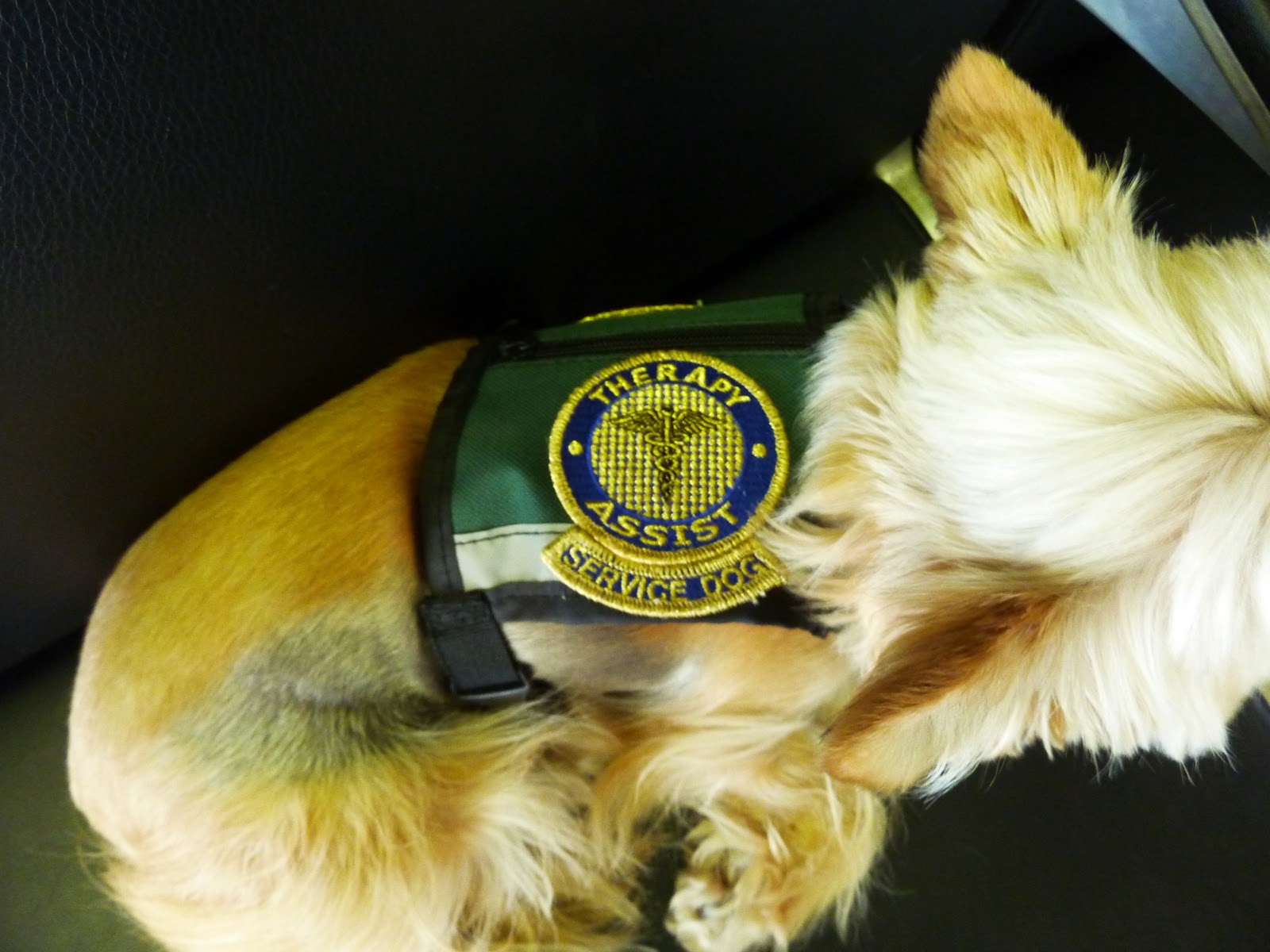
I recently had a conversation with an older lady at the Dallas airport. She was carrying a teeny Yorkie (like 2 lbs teeny). I chatted with her for a few minutes and learned she travels quite a bit and she takes the dog everywhere she goes. The dog was wearing a "Therapy" dog vest. So I asked about that. She says she got a physician's signature to inform the airlines that she needs to dog to keep her calm while she travels. I'm thinking that's a very very clever way of getting to take your dog with you on airplanes without having to pay the fee they charge for pets. (when I flew Lola home with me last summer I think I paid $80 one-way....wished at the time they'd let me use frequent flier miles, but they won't)

Here's Tommy. I met him and his owners at the Dallas airport. Tommy was rescued from a dog shelter. He was sitting calmly on a seat in the gate area . I noticed he had on a little "therapy" vest so I asked his owner what kind of therapy he provides. She said "emotional support".


Tommy -adopted from a dog shelter...one VERY happy/lucky little dog!

Tommy

Here's Apple.  I met her and her owner at O'Hare airport.  They were headed to Ohio.  Apple is a 3 y/o poodle.  She was very sweet (ok, "sweet" means she seemed to like me petting her).  Notice Apple doesn't have a therapy vest.  Technically, that means she's supposed to stay in her carrier at all times while she's in the airport on on a plane.  (I got that lecture when I brought Lily home - but on the flight from Miami to Chicago, I sat next to a pilot and he wanted to hold her.  I said "are we allowed to do that?" and he says "they won't say anything to me" - so he held Lily most of the flight tucked inside his jacket)


I "met" Rena at the Dallas Fort Worth airport.  Rena is a Bichon and she was returning to Chicago from Mexico where she had vacationed with her family.  Her owners warned me she bites (apparently traumatized by a small child when she was a puppy).  You could tell she was a seasoned traveler.   She sat quietly with her head out of her carrier.  When we had to change gates (via the air link tram) from the B terminal to the C terminal, we had to ride up a very steep escalator.  Rena just repositions herself to be more stable for the ride up.  Her owners say they take her everywhere they go.  They paid $300 for her roundtrip ticket.  I told them about the "therapy dogs" I've seen and suggested  maybe she could become a therapy dog and fly for free.

The most heartwarming airline dog story was a couple of years ago.  It was a very hot afternoon.  Our flight was delayed.  There was a woman, visually impaired, with a large dog (a labrador).  The delay was several hours.  About the time I thought of asking his owner if I could get the dog a drink or take him on a bio break, along comes the pilot for our flight.   He asked if he could take the dog outside and he did after she coached him on what the dog would expect since he's been specially trained.  I wondered at the time if they found grass out there among all the jets or if the dog just lifted his leg on a tire somewhere.  I also wondered if the pilot was a fellow dog lover or just a thoughtful/nice guy - or maybe both!  I wrote a note to the airline to acknowledge him. 

When I retire and travel just for fun, I'm going to get my dog(s) a therapy certificate so they can wear one of those little vests and travel free.   

Tuesday, February 22, 2011

Effingham IL - small but worth some exploration

Last night I posted a comment on Facebook about a long drive to the southern tip of Indiana and how I didn't see anything very interesting on the drive other than a coyote. I shared that story at the hospital where I was today and one of the guys said "you didn't think the giant cross was interesting?"   I knew immediately what he was referencing as I have passed by it many, many times.

Located alongside the intersection of Interstates - I-57 and _70 at Effingham, IL - the cross is 198 ft tall (<200ft to avoid the FFA requirement of a flashing light at the top), 113 ft wide.  180 tons of steel, built to stand strong in winds up to 145 mph (what did we ever do without Google???). 

I have never taken the time to stop and check it out up close, but I have put that on my list of  "things to do" on my Harley as they have a "Blessing of the Bikes" on April 9.  After the short service, the riders are invited to The Harley Barn (the Harley Davidson shop in Effingham). 

If you are ever in the Effingham area, there is another stop that I recommend and that is the Boos Block's outlet store.  In case you're not familiar with this company, they make amazing wood butcher blocks.  I've seen them at high-end kitchen stores for big $$.  At the outlet store you can get them for great prices...usually because there's a small flaw - sometimes just the way the woodgrain looks.  They sell other kitchen items including stainless steel tables, butcher block tables and knives.  If my kitchen were wider, I'd be getting one of the butcher block tables.  They are beautiful.  It's amazing to me that this world-famous company is in this small town downstate IL. 

3 in x 18 in.  Weighs 36 lbs.  Retails for $145.  A fraction of that price at the outlet store.
One other Effingham stop I have yet to make is the Firefly Grill.  Maybe I'll make it a 3-in-1 stop in April.